The Feast of St. Margaret of Scotland. Patron of large families, the death of children, learning, queens, widows and Scotland. You can read more here and here.
And a very Happy Feast Day to my second favorite Sister.

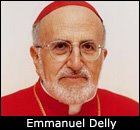
Baghdad, Jun. 08, 2006 (CNA) - Emmanuel III Delly, Patriarch of the Caldean Catholic Church in Iraq, told AsiaNews today that while Abu Musab al-Zarqawi’s death brings hope for the future, ultimately dialogue and the way of love must conquer the hearts of the Iraqi people. The death of the leader of Al Qaeda in Iraq was confirmed by US and Iraqi officials today.
Officials of both governments were overjoyed at killing the most wanted man in Iraq, who was the mastermind of several terrorist attacks and multiple violent murders in Iraq.
President Bush, commenting on the death said, "The ideology of terror has lost one of its most visible and aggressive leaders. Zarqawi's death is a severe blow to al Qaeda."
However, while the killing does deal a blow to the major terrorist organization in the world, the threat of terror still exists in a very real way in Iraq and abroad and Archbishop Delly hopes that new ways are found to bring peace in his country
“This is a great hope for the end of violence which torments,” the Archbishop said. “but we repeat that the best solution is always in dialogue and not in killing. Killing each other for personal reasons can not bring anything good,” Delly continued, “loving each other and not killing - this is the way to keep in mind.”
Father Andrew Greeley, a distinguished author and sociologist, has frequently pointed out that it was not the Council but Pope Paul VI's 1968 birth-control encyclical, Humanae Vitae, that opened the breach within the post-conciliar Church. If the pope had sided with the 2-1 majority of his Birth Control Commission and modified the official teaching on contraception, the post-Vatican II history of the Church might look entirely different.
And yet the new bishop of Kansas City-St. Joseph, Robert Finn, a member of Opus Dei, has been dismantling much of what had been put in place by his three immediate predecessors: Charles Helmsing (1962-77), John Sullivan (1977-93), and Raymond Boland (1993-2005).
Priests, nuns and lay people who have served in various diocesan offices and agencies established and supported by these three bishops have, in a matter of months, been fired or resigned, and programs have been closed down or suffered cuts in budget and staff (National Catholic Reporter, May 12).
Were Bishops Helmsing, Sullivan and Boland unworthy shepherds, like the hired hands mentioned in the Fourth Gospel (John 10: 12-13)? Did they lead their flocks astray or throw them to the wolves? Were they grievously wrong in their pastoral teachings, policies and appointments? If so, how is a Catholic to know when any bishop is to be respected and obeyed, and when he is not?



"Man of modern times has radicalised the tendency to take the place of God and substitute him," it states. "Never before in history has human procreation, and therefore the family, which is its natural place, been so threatened as in today’s culture."
"The human being has the right to be generated, not produced, to come to life not in virtue of an artificial process but of a human act in the full sense of the term: the union between a man and a woman."
The document specifies that abortion is a crime which must be punished. "Today people want to trivialise abortion with the claim that authorities must not penalise this abominable crime," says the 57-page document signed by Cardinal Alfonso Lopez Trujillo, the head of the Pontifical Council. "It is not acceptable that a crime should remain unpunished."

"So in a way, you could say that traditional foes learned that consensus is possible and that we believe that consensus can contribute to development of a coherent public health policy," said Dr. Sharon Camp, president of the Guttmacher Institute.
Other areas which they agreed should be subjects of research are:
— The content of school-based sex education.
— Connections between violence and sexual health.
— The impact of religion on sexual practice.
— The sexual health of military personnel, persons with disabilities, prison populations and the aging.
— Barriers to parent-child communication about sexuality.
— The impact of the Internet on sexual health.
The effort by the Vatican and its allies to control theological debate reflects little trust in the capacity of theologians to criticize one another-something they have never been reluctant to do-and even less trust in the best-educated laity in Catholic history that is hungry for intellectual engagement with the faith that is not condensed and condescending. Defenders of the CDF’s actions like to say that theology is an ecclesial, not merely an academic, vocation. I agree. It is precisely because theology is done by and for the church that it requires the highest gifts of theological intelligence and imagination. Some of the best theological talent available to the church today is found outside the clergy. If these lay theologians teach in Catholic colleges or seminaries, they are placed under strict control; if they teach in Protestant or secular schools, they are largely ignored. Many in the hierarchy seem indifferent to the academic theological community, while others seem hostile to the climate of intellectual freedom that theology needs.
Like Aquinas, theologians today ask hard questions in the language of our own age concerning the truth of the gospel, not in order to erode or compromise that truth, but to allow its splendor to become more powerfully manifest. Theologians of this age, as of every age, are obliged to inquire into the ways in which the structures and processes of the church itself best serve the truth of the gospel. In every age, Christians must struggle with deep intrinsic tensions that derive from the church’s peculiar and paradoxical character. On one side, there is what we might call the resurrection principle: the powerful gift of the Holy Spirit that comes from the exalted Lord Jesus and pushes believers toward transformation and growth, toward the exercise of spiritual gifts and of responsible freedom in response to the urgings of the Spirit. “The Lord is the Spirit,” declares Paul, “and where the spirit of the Lord is, there is freedom” (2 Cor 3:17). In Jesus, all previous human understanding of the law and prophets is transcended. And because this spirit of freedom comes from the Lord and not from humans, its exercise must ultimately be responsible to the Lord rather than to humans.
It follows that revelation is open and ongoing in the world, specifically in human experience. If God acts in human stories, both within and outside the structures of the church, then the church’s relationship to revelation is not simply that of protector and purveyor. The church must also find a way to become an effective interpreter of God’s self-disclosure in the world. This is not a plea for the privileging of every private human experience. Not every human story reveals God. It is a plea to consider the theological implications of the millions of stories of believers (such as women and homosexuals) whom the church has persisted in regarding as “objects” to be “explained” rather than subjects, that is, persons through whose struggles the Holy Spirit speaks a word to the church.
The theological impoverishment of the church today is real and if something is not changed, it will undoubtedly get worse. Perhaps it’s too much to hope that the present model of the church as household can open itself to a healthy conversation with the image of the church as the living body of the resurrected Christ, particularly if the present heads of household think that theirs is the only model that is true to revelation. But they are wrong. The alternative (and, I insist, complementary) image of the church is, if anything, truer to the good news as found in Scripture. Those of us who long for a church in which it is possible to be both smart and holy, both loyal and critical, live in hope that something of this vision may gain recognition. Still, suppose the big chill continues, through the papacy of Benedict XVI (despite our fondest hopes) and the papacies to follow. What can theologians do? They can continue to speak prophecy and to practice discernment among God’s people. What is at stake is the integrity of the church’s witness to the living God.

Kneeling "is clearly rebellion, grave disobedience and mortal sin," Father Martin Tran, pastor at St. Mary's by the Sea, told his flock in a recent church bulletin. The Diocese of Orange backs Tran's anti-kneeling edict.
Kneeling is an act of adoration. You almost automatically kneel because you're so used to it. Now the priest says we should stand, but we all just ignore him.
Because the earliest Christians viewed Jesus as God and man, Madden said, they generally stood during worship services to show reverence and equality. About the 7th century, however, Catholic theologians put more emphasis on Christ's divinity and introduced kneeling as the only appropriate posture at points in the Mass when God was believed to be present.
Things started to change in the 1960s, Madden said, when Vatican II began moving the church back to its earliest roots. What has ensued, he said, is the predictable struggle of an institution revising centuries of religious practices.






"After the case was reopened in 2004, the congregation's promoter of justice, Maltese Msgr. Charles Scicluna, began to collect additional testimony. Sources told NCR that the eventual number of accusers who came forward against Maciel was "more than 20, but less than 100."
Refusal of Communion implies, according to applicable Church law, that the person who is not admitted to Holy Communiion is one who is excommunicated or interdicted, or obstinately persisting in manifest grave sin. (cfC915)
Given the long standing practice of not making a public judgment about the state of the soul of those who present themselves for Holy Communion, it does not seem that it is sufficiently clear that in the matter of voting for legislation that supports abortion such a judgment necessarily follows. The pastoral tradition of the Church places the responsibility of such a judgment first on those presenting themselves for Holy Communion.
"One such approach would be an actual mechanism of the conference to facilitate some consensus and unified pastoral practice," he said. "Another approach, which would be less formal but perhaps more effective, would be the commitment on the part of all the bishops to discuss beforehand, through some conference structure, decisions that will impact all of the bishops and the church as a whole."
He said a formal mechanism of review by the conference before barring a politician from Communion would require either a two-thirds vote of the bishops and a mandate from the Vatican or a completely unanimous decision by the bishops.
Parents allowed to remove children from sex abuse training programs.
WASHINGTON (CNS) -- New regulations issued May 15 by the U.S. bishops allow parents to remove their children from diocesan-sponsored training programs in child sex abuse prevention. The programs are part of the bishops' policies to prevent child sex abuse. But parents in some dioceses have objected to such programs, saying the training constitutes sex education, which they feel is the primary responsibility of the parents. Dioceses and Eastern-rite eparchies are required to provide the training -- known as safe environment programs -- to children attending church-run schools and those who participate in church programs. Such training is also required for clergy, religious, lay employees, parents and volunteers who come in contact with children. Under the new regulations adopted by the U.S. bishops' Administrative Committee, dioceses and eparchies are still required to provide the safe environment programs. Parents, however, can choose not to have their children participate



Marriage and family life are the basis of all civilization, but they can fluctuate between heaven and hell and always take hard work, time and energy.

Bogotá, May. 12, 2006 (CNA) - In response to a ruling by Colombia’s Constitutional Court making the country the first in Latin America to legalize abortion, the country’s bishops said Thursday that civil disobedience may be necessary to resist the new immoral law. Likewise, Bogotá’s Archbishop, Cardinal Pedro Rubiano Saenz is threatening excommunication against the responsible lawmakers.
The president of the Bishops’ Conference of Colombia, Archbishop Luis Augusto Castro, rejected the Court’s decision to legalize abortion in certain cases and said it was a crime against human life. “A door is being opened toward the elimination of the innocent lives of so many children who will not be allowed to live, we have always said this is wrong,” the archbishop said.
“We continue to say that this is an act against the life of the unborn and it is immoral.”
Likewise, Cardinal Rubiano told Columbia’s El Tiempo newspaper that “all those who commit the crime, the sin of abortion, will be excommunicated immediately."
“This applies as well to those who foster or assist abortion,” he added, insinuating that the justices who passed the ruling to allow abortion in some cases, might be included in this excommunication, without mentioning them explicitly.
Cardinal Rubiano lamented that the justices did “open the door” for a broader legalization of abortion. “Draw your own conclusions,” he added, stressing that abortion is “a deliberate murder in the womb of the mother.”
For his part, Archbishop Castro said that “We must have a two-fold perspective, that is, to see the situation of the mother and help her in every way, but also look after the child, because nobody does it…Nobody looks after the baby, there is no consideration for a child that has been conceived, who tries to move forward in this world but has his possibilities cut off.”
The archbishop noted that in the conception through rape, “the child is innocent…the criminal should be punished and put in jail for a longtime, but the child should not have to pay for the sins of another. He is an innocent baby. In this sense we defend the life of the baby as well.”
While Archbishop Castro underscored that a child conceived through rape is “the result of a deplorable action,” he emphasized that what exists in the mother’s womb is a child who committed no crime. Many women who have conceived through rape, he noted, “accept their babies because they understand that the child is one thing, and the person responsible for the rape is another.”
The bishops of Tunja and Engativa decried the Justices for taking the easy way out and they noted that “not everything that is legal is moral.” They said Colombians should question the legitimacy of the ruling.
“It is sad that the Justices have chosen the easy way, which is the path to crime,” said Bishop Hector Gutierrez Pabon of Engativa. “In the Catholic Church, there is no such thing as a first, second or third class citizen and it should be this way also in society.”
“Many people will think that because it is legal it is okay. No! What is legal is not always morally licit,” he added.
"The historic moment we are living calls for Christian families to attest with courageous coherence that procreation is the fruit of love," said the Pontiff.
"At times it seems families are besieged by fear in the face of life, paternity and maternity," Benedict XVI continued. "It is necessary to give back confidence to them so that they can continue to fulfill their noble mission of procreation in love."

The sexual revolution tried to free women and men from set-in-stone roles. But the irony turns out to be that having a degree of certainty about what you want (and being in a peer group that feels the same way) is helpful in making people happy. Having more choices about what you want makes you less likely to be happy with whatever choice you end up settling on. Choosing among six brands of jam is easy. But consumers presented with 24 types often leave the supermarket without making a purchase. In much the same way, the more you scrutinize a relationship, the more likely you are to find fault with it. The study's authors, W. Bradford Wilcox and Steven Nock, speculate that fault-finding on the part of wives makes it hard for men to do the emotional work that stabilizes marriages. Meanwhile, traditionalist women—a significant portion of whom are Christian—expect less emotional work from their husbands, Wilcox and Nock speculate, which makes it easier for them to shake off frustrations, and less likely to nag. Whether or not any of this is the case, we do know that traditional marriages have the advantage of offering clearly defined roles. And traditionalist wives have a peer group fundamentally in agreement about what it wants and expects from husbands, creating a built-in support system.
Consider the evidence that evangelical women—who in general endorse traditional gender roles—are better at adjusting psychologically to situations they don't find ideal than feminists are. Studies of evangelical wives who have to work for financial reasons show that, as rigid as gender roles are in their community, women are fairly adept at being what sociologist Sally Gallagher calls "pragmatically egalitarian." That is, they continue to be happy with the division of labor, and to see their husbands as providers, even though they'd prefer to be at home. It's a kind of utilitarian double-think, Gallagher and others argue—and it helps explain why traditionalist women who work might consider themselves happier than feminists who are still struggling to feel secure in their decisions.

U.S. Sen. Rick Santorum (R., Pa.) yesterday called for federal funding of research that would involve creating an altered human embryo [kind of like a baby Frankenstein]- one that could yield precious stem cells but not implant in a uterus.
snip-
"There are some who believe that... there is controversy around these new entities - these collections of cells - as to whether it is an embryo or not," [there are some- wow it almost sounds like he is talking about other people]Santorum said during a news conference at the University of Pennsylvania. "I feel comfortable, given all of the conversations I have had with a number of bioethicists, that these are appropriate steps to take."
But yesterday, Santorum came out in favor of another "attempt to bridge the gap," namely the 2005 report by the President's Council on Bioethics. This report outlines what it calls "ethically uncontroversial" concepts for getting embryonic stem cells - including creating an embryo engineered so that it could not keep growing.[why don't we take people who are dwarfs and experiment on them and kill them because they are unable to keep growing? Idiots.]
"I think Sen. Specter would say [the bill] is not exactly what he wanted. And it raised some concerns for me," Santorum said. "Both of us have compromised."
Yesterday, lead researcher Rudolph Jaenisch of the Whitehead Institute for Biomedical Research in Cambridge, Mass., said he was glad that his experiment is spurring legislative debate aimed at funding an acceptable compromise. But at the International Center for Technology Assessment, which neither advocates nor opposes embryonic stem-cell research, bioethicist Jaydee Hanson said making "defective embryos" is no solution.
"Simply redefining something as 'not an embryo' doesn't make it not an embryo," he said.
The other novel approach for obtaining embryonic stem cells involved removing a single cell, called a blastomere, from an eight-cell mouse embryo. Cambridge, Mass., stem-cell researcher Robert Lanza tricked the blastomere into becoming an embryonic stem cell, while the embryo was implanted and developed normally in a mouse. But since a single human blastomere is theoretically able to develop into an embryo, this method, too, raises ethical questions about what constitutes a human life.

FDA medical officer Andrew Dayton asked the Blood Products Advisory Committee (BPAC) whether it was prudent to change the donor deferral policy to ban only men who disclosed having sex with another man within the last five years. Dayton and his colleagues analyzed the projected risk that relaxing the donor deferral rule would have on the nation's blood supply and presented the committee with this data. After much deliberation, the BPAC members voted 7 to 6 to maintain the current deferral policy.
The serological tests routinely performed on all donated blood to detect HIV and other blood-borne viruses are sensitive enough to prevent all but about 10 HIV-infected units from entering the blood supply each year, said Dr. Michael Busch of the University of California-San Francisco. The infected blood that does defy the rigorous testing protocol causes two to three HIV infections each year, he said.